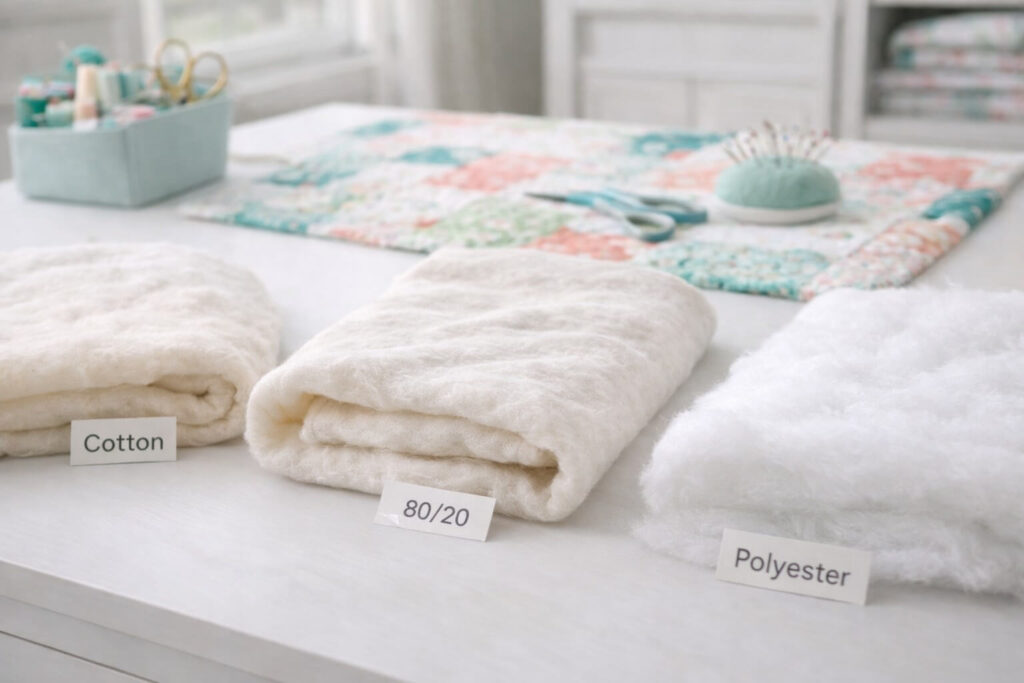
If batting feels confusing, you’re not doing anything wrong. The 52 Quilts Challenge has forced me to confront many things. Before the 52 Quilts Challenge, I made far more quilt tops than finished quilts, so my batting preferences have developed quite slowly over time.
What I’ve learned over time isn’t a list of rules. It’s a set of preferences shaped by actual use.
I’ve liked something about every type of batting I’ve tried. I’ve also been mildly annoyed by every type of batting I’ve tried. None of them have ruined a project. Some have surprised me.
A few have taught me what I value most: coziness, drape, affordability, and how a quilt behaves in real life (not in theory).
Personally? I’m not making museum pieces. My genuine hope is that the quilts I make for my family, and for others, will be dragged around, loved hard, and very well-used. If a quilt looks imperfect but clearly adored, I consider that a resounding win.
This post is for beginners and confident beginners who want reassurance more than perfection. (Some links in this post may be affiliate links. This means that if you click a link and make a purchase, I may earn a small commission at no extra cost to you. I only share products and resources I genuinely use and love.)
Early Confusion: What Do You Even Buy?
Early on, I didn’t know what to pick for which type of project, or even what I liked. I didn’t have strong opinions yet, and I don’t think beginners need them.
Batting felt like one of those things you were supposed to understand immediately, even though most guidance is written as if you already do. Loft. Fiber. Drape. Warmth. Stitch spacing. Shrinkage. It’s a lot. Especially when you’re just trying to finish a quilt without talking yourself out of it.
Over time, my preferences emerged naturally as I finished more projects.
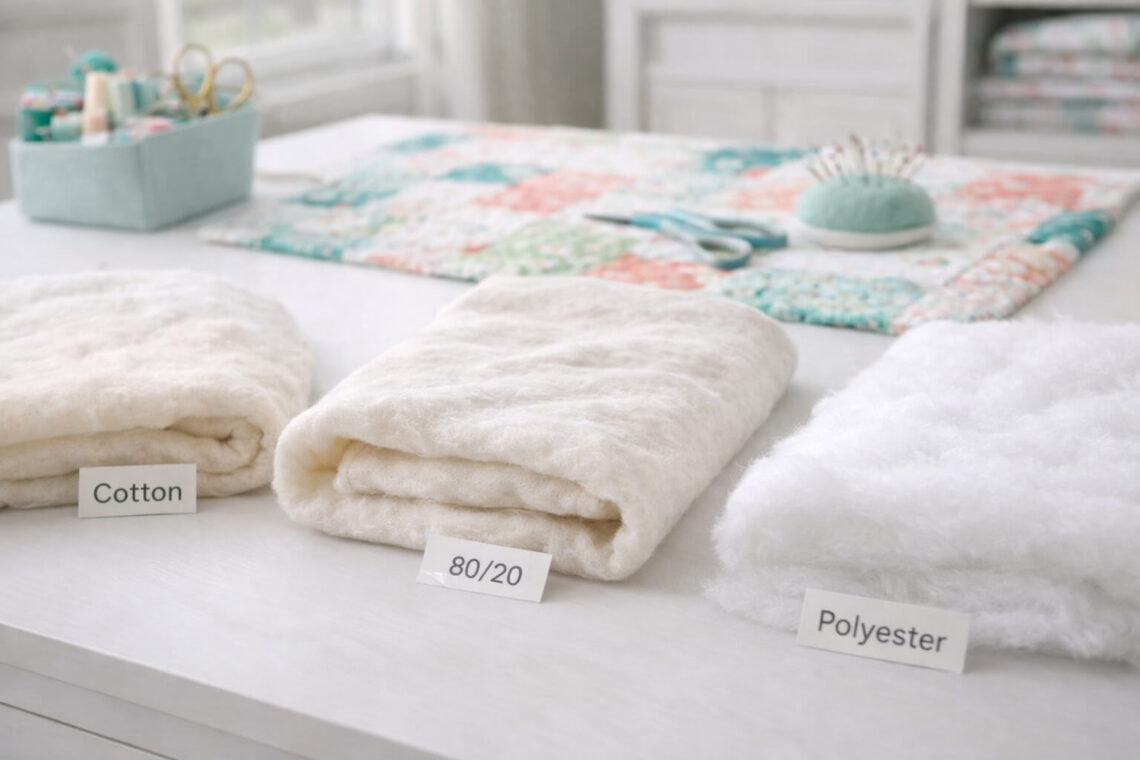
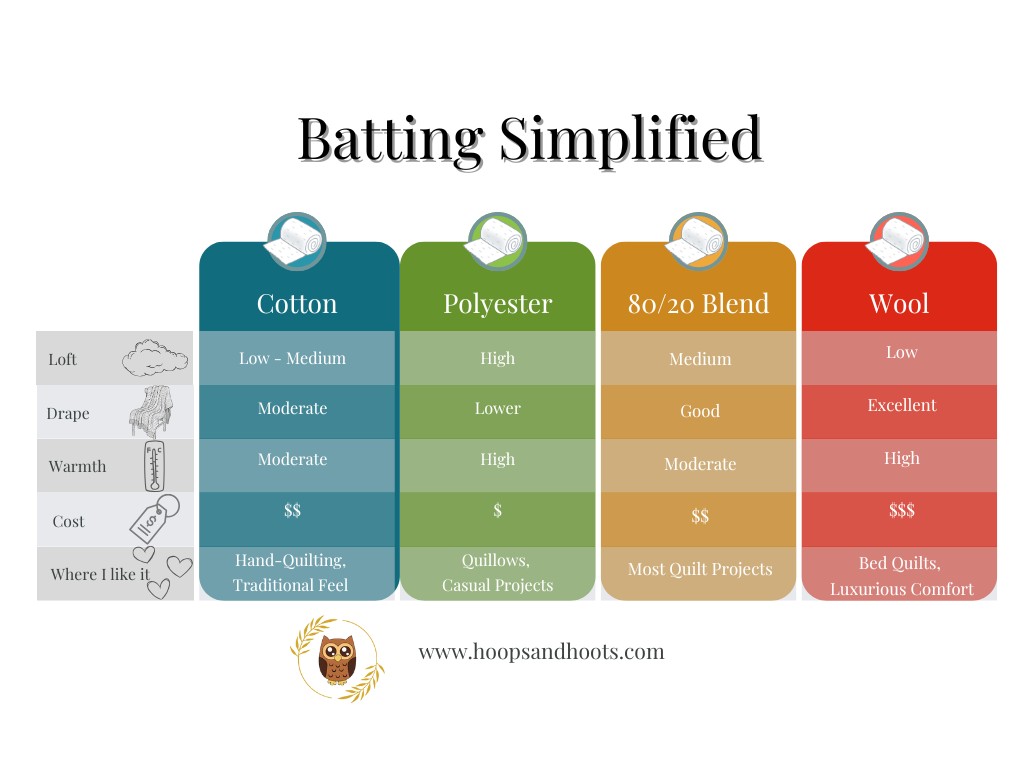
Before we get into the details, here’s a quick, at-a-glance comparison of the batting types I actually use and why. This isn’t a rulebook. It’s just a snapshot.
What I’ve Enjoyed (and Not Enjoyed) About Different Battings
Polyester Batting (High Loft)
For casual projects like quillows, I’ve consistently preferred loftier polyester batting. I like quillows to be fluffy. My brother, for example, prefers them flatter – a helpful reminder that there is no universal “correct” loft. People like different things. Shocking, I know.
Poly batting has some very real advantages:
- It’s inexpensive.
- It’s warm for its weight.
- It creates that cozy, puffy feel many people expect.
There are tradeoffs. When poly batting is exposed during construction (as it often is in quillows), it can be fussier under the walking foot. I notice more resistance and drag compared to other battings. It hasn’t caused actual problems for me, but it’s something I’m aware of while quilting.
I also tend to avoid quilting my quillows from the batting side because I don’t want poly lint inside my machine. That’s a personal choice, not a rule — but it does mean poly batting feels a little more hands-on during construction.
Still, for quillows? Poly makes sense to me. It’s affordable, forgiving, and does exactly what I want it to do.
Cotton Batting (100%)
Cotton batting feels steady and predictable. It doesn’t surprise me much — which, depending on the day, can be a compliment.
It’s a solid option when I want a more traditional feel and clearer stitch definition, especially if hand quilting is involved. It can feel heavier and less drapey than other options, particularly before washing, but it behaves well during basting and quilting.
I don’t reach for cotton because it excites me. I reach for it because it quietly does its job.
80/20 Cotton/Poly Blend
If there’s a batting I return to again and again, it’s an 80/20 blend.
I didn’t choose it originally because I had strong opinions. I chose it because it seemed like a reasonable middle ground. Over time, that “middle ground” has become a genuine preference for many quilts.
It balances:
- softness
- moderate loft
- manageable quilting
- and cost
If someone asked me, “Just tell me what to buy so I don’t mess this up,” this is probably what I’d recommend. Not because it’s perfect — but because it’s unlikely to surprise you in unpleasant ways. Sometimes boring is exactly what you want.
Wool Batting (Thin, Warm, and… Particular)
Wool batting has been the most interesting and the most nuanced of all the battings I’ve used.
I love the drape. I was genuinely surprised by how warm it is, given how thin it feels. A recent bed quilt I made (Fall Framed Windows) is luxuriously comfortable, cozy, and light — exactly what I want in a bed quilt for my room.
That said, wool has also been the most delicate batting I’ve worked with.
During basting, I experienced distortion along the edges. The batting caught on the table and stretched in places, which later showed up as crumpling when quilting. I want to be clear that this is my experience, not something I see widely documented by manufacturers or consistently reported by other quilters. It may have been my method, my setup, or simply my learning curve with wool.
I don’t think wool is “bad”. I think it’s particular. If I use it again, and I likely will, I’ll be more intentional about supporting the batting fully during basting and avoiding situations where the edges can catch and stretch.
Wool is also the most expensive option I’ve used. I’m leaning toward it for certain quilts despite that, but only when I’m okay with the cost, the thinness, and the extra care it may require.
A Love Letter to Batting Scraps
I really like batting scraps.
I like joining batting scraps from quilt projects past when the loft and material match. I like using leftovers for smaller projects like coasters. I like not throwing away perfectly usable material just because it isn’t pristine or full-sized.
Batting doesn’t need to be precious to be effective.
Scrap batting works because:
- it’s already paid for
- it’s already tested
- and it often ends up in projects meant to be used hard anyway
If a seam is hidden inside a quilt sandwich or a coaster, I’m not worried about it. In fact, there’s something satisfying about using every last bit — like the quilt is quietly reminding me that usefulness matters more than perfection.
Stitching Distance and Real-World Use
Batting requirements often include maximum quilting distances, which can sound intimidating on paper.
In practice, I’ve found this far less stressful than it appears. Even when I tie quillows instead of quilting them, I stay within the typical 4–6 inch spacing most battings recommend. I haven’t had batting become a problem in any of my projects so far – and that experience matters to me more than theoretical limits.
Additional (And Perhaps More Educated) Resources
If You’re Overthinking This
If you’re new and stuck, here’s my most reassuring advice: Buy something reasonable and make the quilt.
You’ll learn more from finishing one imperfect quilt than from reading ten batting guides.
Again, I’m not trying to create heirloom pieces. I’m creating quilts meant to be used – pulled onto couches, crumpled at the foot of beds, taken on trips, and loved hard. The imperfections don’t bother me. In fact, they’re often my favorite part.
A quilt that’s clearly been used is my favorite kind of quilt. Now go make that quilt of yours…
Follow me on Instagram and check out my Quilting-Themed merch on Etsy